Beauty Salons: Digital Booking and Offers
A salon sells booked time, not a product, so every lost slot is unrecoverable. Here is how to run booking and offers digitally and cut late cancellations.
Business Basic plan · 46 SAR a month, billed yearly

A salon does not sell a product; it sells booked time with a specific person, and that changes every operational calculation. An empty chair at four o'clock cannot be sold at five, and an appointment cancelled an hour beforehand is a complete, unrecoverable loss. So what salons gain most from going digital is not a modern appearance but three specific things: taking booking requests outside working hours, reducing late cancellations through reminders that make early cancellation easy, and turning a seasonal offer into a shareable, measurable page instead of a poster in the window.
Why salon booking is harder than it looks
Booking a restaurant means a table for an hour. In a salon the equation has three additional layers.
Duration varies enormously between services. A trim is twenty minutes; a full colour can exceed three hours. A system that books a fixed-length "appointment" creates chaos in the diary.
The person matters. A client used to a particular stylist will usually not accept a substitute, and that is not fussiness but trust built through experience. Booking that does not allow choosing the person loses much of its value.
Services chain together. Some clients book two or three services in one visit, sometimes performed by different specialists in a specific order.
A good page in this sector reflects that complexity: service, duration and person, rather than an abstract "book an appointment".
Prices: the first thing clients look for
In this sector particularly, price is the first and most repeated question.
A salon that does not publish prices takes dozens of calls a day whose only question is "how much is X?", while losing everyone who never called at all. A client comparing three salons eliminates the one whose cost she cannot find — not because it is expensive, but because the unknown is uncomfortable.
A service list with prices on a digital page settles this permanently, and updates when prices change with no reprinting.
The reasonable exception is services priced by hair length, condition or duration. For those, publish a clear range — "from X to Y depending on length" — rather than leaving it blank. A range builds an expectation; a blank builds suspicion.
Late cancellation: the most expensive problem
This is the largest operational loss in salons, and the most fixable.
The difference between cancelling a day ahead and cancelling half an hour ahead is enormous: the first slot can be refilled, the second is a certain loss of an hour or more of a specialist who is present and being paid.
What actually helps:
A reminder that allows one-tap cancellation. A client who knows she cannot come but dreads the awkward phone call will simply not appear. Make cancelling easy and you find out early.
A ready waiting list. A slot released a day ahead can be offered immediately to someone who asked and found nothing.
A deposit for long services. Services blocking three hours of a specialist's time justify one. This is normal and accepted in the market for larger treatments, and the policy must be written and visible before booking rather than after.
A published policy applied consistently. A policy enforced on one client and waived for another generates more resentment than having no policy at all.
Seasons: salons live on peaks
Demand here is not spread across the year; it concentrates into seasons known well in advance.
The days before both Eids, where the peak is very sharp and runs late.
Wedding and occasion season, when long, high-value services are booked.
The start of the school year and the end of holidays.
Every weekend, reliably.
Useful preparation: open Eid bookings at least two weeks before the season, because a salon opening them on the last day spends that day apologising.
During a peak, a page clearly showing remaining availability halves the calls. A client who can see the twenty-fourth is full does not ring to ask about it.
Building seasonal offers
A digital offer beats a poster for two reasons: it expires by itself on its date, and it is shareable — and sharing between friends is the strongest channel in this sector specifically.
Offers that work in salons follow recurring shapes: a package combining two related services at a better price, a discount for booking during quiet hours (weekday mornings), or an offer for bringing a friend.
That last one deserves attention because it exploits a natural distribution mechanism: a satisfied client brings another, which is the cheapest growth available to a salon.
Building offers and codes is covered in digital coupons and offers for shops.
Privacy: a defining consideration here
Women's salons in Saudi Arabia operate under a high expectation of privacy, which imposes rules that do not apply elsewhere.
Never publish images of clients without explicit permission, even if the photograph shows only hair or an angle without a face. Verbal consent in a moment of satisfaction is not enough; written is better.
Be especially careful with before-and-after photographs, which are the most tempting and the most sensitive. The safer alternative: work photographed on models with consent, or images of the space and the tools.
Collect the minimum: name, number, requested service. A booking form needs nothing else.
Never publish client lists or use names in examples or testimonials without permission.
A salon known for guarding its clients' privacy earns loyalty no campaign can buy.
Reviews: ask at the right moment
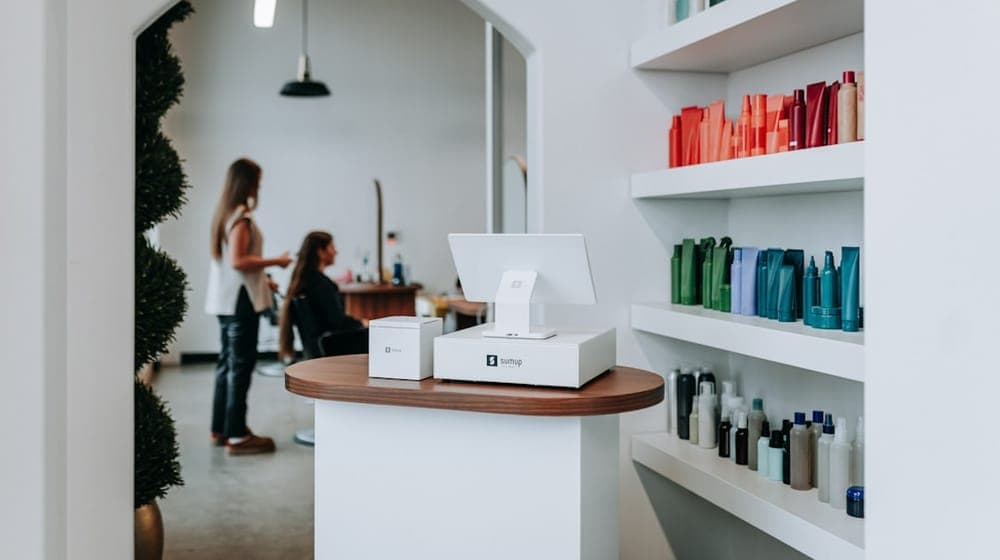
The ideal moment in a salon is obvious: immediately after the service and before the client leaves the chair, while she is pleased with the result and looking at it in the mirror.
 Photo by Blake Wisz on Unsplash
Asking two days later by message reaches someone who has moved on, and the response rate is far lower.
A small tag at the payment point and a line from the stylist — "if you're happy with today, a review really helps us" — is all it takes. Full methods are in how shops collect customer reviews.
The most-requested stylist: opportunity and risk
In many salons one or two specialists absorb most of the demand.
That is an opportunity: their name on the booking page brings new clients, and their slots fill first.
It is also a risk: their diary fills and clients who could have been served are turned away, and when they leave they take a share of the clientele with them.
The practical digital response: show everyone's availability rather than only hers, with a short description of each specialist's strengths. A client who cannot get her preferred stylist may accept another if she can see that person specialises in the service she wants — but if she sees nothing, she leaves.
What the numbers tell you
Here the figures answer specific operational questions.
Which service page gets opened most shows what people are looking for, and may reveal demand for something you do not yet offer.
Which times are requested and unavailable sketches an alternative schedule: repeated rejected requests for late evening slots point at hours worth considering.
Cancellation rate before and after reminders is the direct measure of whether what you implemented worked.
Reading these is covered in analytics: what the numbers tell you.
Start with one step
The practical order: the service list with prices first — that alone noticeably reduces calls. Then taking booking requests. Then reminders. Then seasonal offers, two weeks before the next season.
Each step works on its own and does not wait on the ones after it.
With AurCard your services, prices, opening hours, booking and offers live on one page a client opens from her phone.
Read next
How Much Does a Digital Business Card Cost — and How Does It Compare to Print?
Paper looks cheaper because you only see the print shop’s invoice. Here is what a digital card actually costs, and a four-step method to work out your own print cost with your own print shop’s numbers.
The Personal Data Protection Law for small businesses: what actually concerns you
Not a legal lecture — five practical questions a shop owner asks about customers’ numbers, and how to answer them with tools that exist.
The Booking and Appointments System
A booking system captures the appointment requests arriving after hours that vanish silently today. Here is how to set it up and how to cut no-shows.