Turning Your Restaurant Into a Digital Experience
Digital transformation in restaurants is not an app — it is removing steps from the guest journey. Here is what to digitise and what to leave human.
Business Basic plan · 46 SAR a month, billed yearly
Digital transformation in a restaurant is not buying an app. It is removing steps from the guest journey and reducing the questions your staff answer repeatedly. The sequence that delivers the most for the least: a digital menu opened from a code on the table, then a page showing opening hours and location, then table booking if you take reservations, then collecting reviews at the right moment. What should stay human is the welcome, the recommendation and problem-solving — because a guest whose order went wrong does not want a form, they want a person.
Start from the questions your staff keep answering
The easiest way to work out what deserves digitising in your particular restaurant: sit for an hour at peak and write down what guests ask staff.
The list is similar almost everywhere: "what's good today?", "is this spicy?", "is there a vegetarian option?", "how long will it take?", "what time do you close?", "do you deliver?"
Any question asked twenty times a day is a candidate. Not because staff should not answer, but because answering while carrying three plates delays another table.
This approach beats starting from a feature list a vendor showed you. You begin with a problem that exists in your restaurant rather than a solution looking for one.
The digital menu: the natural starting point
The menu is the most-read thing in your restaurant, the most frequently changed, and the most expensive to print. Which makes it the first thing worth converting.
The immediate benefit is that changing a price or removing a sold-out item costs nothing. A restaurant on printed menus faces a daily dilemma: cross items out by hand, which looks poor; tell every table verbally; or reprint at every change.
The second benefit is photographs. A full-colour printed menu is expensive, whereas images in a digital menu cost nothing to print and make unfamiliar dishes far clearer.
The detail, including the common mistakes, is in digital menus for restaurants.
What a restaurant loses by over-digitising
This part is missing from most writing on the subject, and it matters.
A restaurant is not an online store. A large share of its value is the human experience: the welcome, the recommendation, the attention. A guest who sits down and is spoken to by nobody because everything is "digital" feels neglected rather than impressed.
The working rule: digitise what saves time, keep what creates an impression.
The menu is digital because it is information. The recommendation is human because it is expertise. Booking is digital because it is a procedure. An apology for a delay is human because it is a relationship.
The restaurants that lose in this transition are the ones that remove staff from the equation instead of freeing them for what deserves them.
Booking: when it helps and when it hurts
Not every restaurant needs a booking system. A fast-service place working a queue gains nothing and may complicate its operation.
Booking earns its place when you have limited tables and demand that exceeds them at particular times — a weekend dinner restaurant, or somewhere that seats family groups.
The most important practical point: a booking system that is not honoured is worse than none. A guest who reserved and arrives to find their table not ready leaves with a worse impression than one who waited without a reservation. If you enable booking, assign someone to manage it.
Ramadan: the season that changes everything
In Saudi Arabia, Ramadan is not an ordinary month with higher numbers. It is a different operating pattern that deserves separate preparation.
The peak compresses into a narrow window just before and after Maghrib, reservations are requested for precise times, and the questions change: "do you serve iftar?", "how much is the iftar buffet?", "is there a family section?", "when is the last suhoor order?"
Useful digital preparation: a separate iftar menu activated for the month, a page clearly showing Ramadan hours, and a booking method that closes automatically when capacity is reached.
Most importantly, all of this is prepared two weeks before Ramadan rather than on its first day. A restaurant changing its hours on the morning of day one spends that day answering questions it could have avoided.
Delivery: a decision worth costing properly
Delivery apps bring orders, but they take a share of every one and own the customer relationship instead of you — you do not know who ordered, and you cannot reach them afterwards.
The arrangement many restaurants settle on is to stay on the apps for reaching new customers while building a direct channel for repeat ones: a WhatsApp number for direct orders and a page showing the menu and prices.
The direct channel does not replace the apps, but it converts a share of repeat orders into commission-free ones. A customer who has ordered from you ten times does not need an intermediary.
Reviews: timing matters more than asking
Reviews are the single biggest influence on a new guest who has never tried you.
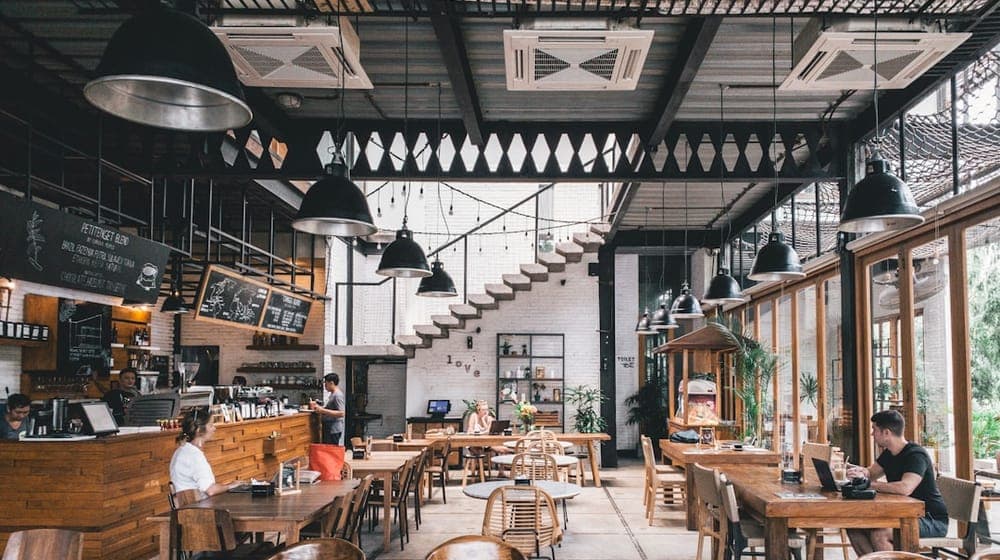
 Photo by Patrick Tomasso on Unsplash
The common error is asking at the wrong moment: a message three days later reaches someone who has forgotten the details. The right moment is immediately after the experience ends and before they leave — specifically, at the bill.
A small sticker on the bill holder or near the exit opens a review page in a second. And a line from the cashier multiplies the response: "if you enjoyed today, a review really helps us."
The full methods are in how shops collect customer reviews.
Seasonal offers
Restaurants in Saudi Arabia work to a clear seasonal rhythm: school holidays, weekends, national occasions, Ramadan and the two Eids.
A digital offer beats a printed one here specifically because it expires by itself. An Eid promotion still hanging two weeks after Eid suggests a place that does not attend to detail; a digital offer ends on its date.
The second advantage is measurability: you know how many people opened the offer page, which you never learn about a poster in the window. This is covered in digital coupons and offers for shops.
Staff decide whether it works
Any digital tool in a restaurant succeeds or fails on the team's attitude to it.
Staff who see it as extra burden will never point to it, and guests will not discover it themselves. Staff who understand it saves them explaining the menu twenty times a day will point to it unprompted.
So explain the benefit to them, not the benefit to management. "This means you don't re-explain the dishes at every table" persuades far better than "this is part of our digital transformation".
A rollout order for an existing restaurant
Month one: the digital menu only, with table stickers. Learn from the numbers which items get opened most.
Month two: the review page and a sticker near the exit, plus training the cashier on the asking line.
Month three: seasonal offers, and booking if your format calls for it.
After that: review the numbers monthly and change one thing at a time.
This staged approach outperforms a wholesale switch, because it lets the team adjust and keeps the cost of any failure contained.
With AurCard your menu, opening hours, location, reviews and offers live on one page a guest opens with a tap from the table.
Read next
How Much Does a Digital Business Card Cost — and How Does It Compare to Print?
Paper looks cheaper because you only see the print shop’s invoice. Here is what a digital card actually costs, and a four-step method to work out your own print cost with your own print shop’s numbers.
The Personal Data Protection Law for small businesses: what actually concerns you
Not a legal lecture — five practical questions a shop owner asks about customers’ numbers, and how to answer them with tools that exist.
Digital Coupons and Offers for Shops
A digital offer expires on its own date and can be measured, unlike a poster in the window. Here is how to build one and know whether it worked.